Description Box :🔍
When deciding between Curved AMOLED and Flat AMOLED screens, consider the trade-off between the benefits of a curved screen and its potential for longer use. Curved displays have a narrow edge-to-edge margin and a thin side profile, but have edge glare, UV glass installation issues and costly screen replacement. With flat AMOLED panels, users in India everyday can avail of precise touch control, budget-friendly protection options and high drop resistance features, as well. For buyers looking to analyze choices thoroughly, doing a smartphone side by side comparison india helps evaluate exact user practicality alongside a flagship vs mid range camera comparison test perspective if multimedia capture matters to your daily routine.
Overview :🧧
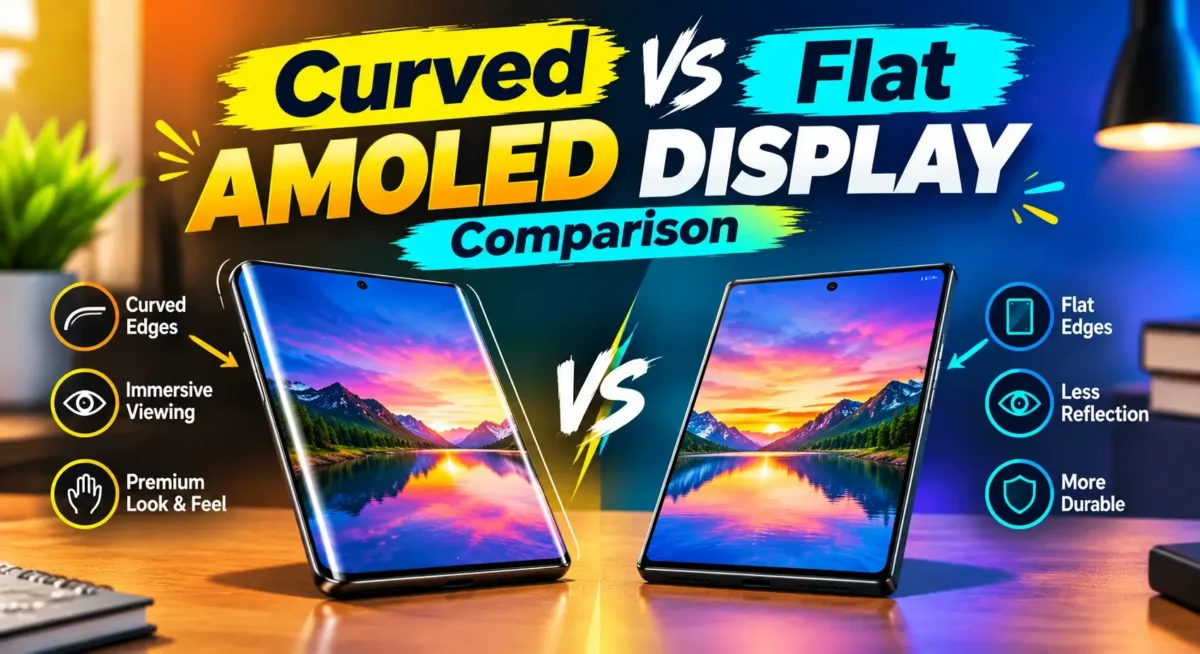
Curved vs Flat AMOLED Displays : Over the past few years, there has been a huge change in the display trends in the Indian Smartphone market. The 3D curved display used to be a restricted feature of only the best flagships but quickly cascaded down to mid range phones from ₹20,000 to ₹35,000. When you perform a detailed smartphone side by side comparison india, the curved AMOLED panels have become a symbol of luxury, design and high-end aesthetics, with brands such as Realme, Vivo, Motorola and Xiaomi widely promoting the feature.
Curved vs Flat Display Comparison : However, conventional Flat AMOLED screens are still commanding a huge market share because people appreciate the durability, easy maintenance, and accurate touch response over sheer aesthetics. Heavy typers, photo takers, and high-FPS gamers spend several hours each day on social media, often checking out every flagship vs mid range camera comparison test online before deciding on their device shape. When deciding between the two screen architectures, it’s important to examine how they perform in the real world and not just in marketing pitches.
Paragraph Verdict: It can be said that curved AMOLED panels are more eye-catching on the retail shelf and are more symbolic of the future while flat AMOLED panels are still the norm in the day-to-day use and hassle-free ownership.
Understanding the Technology: Curved AMOLED vs Flat AMOLED 📱
It’s helpful to understand the methods used in their manufacture to help explain why these displays function differently. Both technologies rely on Organic Light-Emitting Diodes (OLED), which each of the pixels is responsible for. This results in the display being capable of very dark blacks, high contrast ratios and vibrant colors. Any standard smartphone side by side comparison india reveals that the main difference is in the substrate which is under the glass panel.
The flat AMOLED displays are normally made using a rigid glass surface or simpler flat polyimide surface. Unlike curved AMOLED, curved glass substrates are used for flexible plastic AMOLED. This will enable the manufacturers to curve the corner edge of the display around the smartphone’s sides, which will result in lesser side bezels and a wrap around effect.
But, when light-emitting diodes are bent, they do have physical optical effects around a sharp curve. If you watch a typical flagship vs mid range camera comparison test video on a curved screen versus a flat screen, you will notice that bent edges refract light differently, causing edge reflection, slight colour change and the loss of bright uniformity along the edges when looking directly at the front.
Verdict: The optical refractivity and edge colour changes caused by mechanical bending are a problem with curved AMOLED screens, which flat panels don’t have.
Side-by-Side Comparison: Flat vs Curved AMOLED 📋
| Feature / Metric | Curved AMOLED Display | Flat AMOLED Display |
|---|---|---|
| Visual Immersion | High (edge-to-edge wrap-around feel) | Standard (visible side bezels) |
| Ergonomics & Grip | Feels extremely slim and premium in hand | Secure, chunkier grip with less slippage |
| Accidental Touch Rate | Moderate to High (palm touches along edges) | Zero (clean frame boundaries) |
| Tempered Glass Fitment | Requires UV Liquid Glue / Specialized curved guards | Easy standard dry-fit tempered glass application |
| Screen Guard Cost Approx. | ₹400 – ₹1,200 (UV Glass / Hydrogel) | ₹99 – ₹299 (Standard Tempered Glass) |
| Drop Protection & Repair | High risk of corner/edge cracks; expensive repairs | High durability; budget-friendly panel replacements |
| Avg. Display Replacement Cost | ₹7,500 – ₹18,000+ (depending on model) | ₹3,500 – ₹8,500 (standard service rates) |
| Best Suited For | Media consumers, aesthetic lovers, style-focused buyers | Gamers, heavy typists, field workers, long-term users |
Paragraph Verdict: The specification comparison clearly highlights that curved displays trade structural durability and low accessory maintenance in exchange for enhanced visual beauty and slim phone contours.
Daily Usage Factors: Real User Experience Breakdown 👇
A. Ergonomics, Hand Feel, and Aesthetics : Bending a curved AMOLED display smartphone immediately gives it the appearance of a light, thin device. Any practical smartphone side by side comparison india shows that the appearance of the side borders is almost imperceptible since the glass narrows at the mid-frame into metal or plastic. With this design, using smartphones with a 6.7-inch or 6.8-inch screen should feel much smaller and more comfortable in one hand.
On the other hand, flat AMOLED smartphones have noticeable flat side rails. New designs have slight chamfered edges or micro-curves in the back glass, but the front glass is still flat. This will give you a solid and confident leverage for your thumb and fingers. The chances of dropping a flat-screen phone are much slimmer when you can get it to your hand in no time, especially when referenced against a flagship vs mid range camera comparison test holding grip.
Verdict: While curved AMOLED screens are better for modern looks and a slim hand feel, flat AMOLED screens are much more secure and offer a slip-free feel to the hand.
B. Accidental Touches and Palm Rejection : The most recurring issue with curved AMOLED screen in day-to-day usage is ghost touches (palm touches). The base of the thumb is often touching the curved edge of the glass screen when using both hands, like typing a message on WhatsApp or checking out a photography sample in a flagship vs mid range camera comparison test. Although there are advanced AI palm-rejection algorithms by modern brands, there are still false inputs.
Unlike other flat panel displays, flat AMOLED displays do not have “edge register errors”. Since the touch sensitive panel is entirely located within the raised protective bezel, your palm can lie comfortably against the frame without accidentally touching the wrong panel, swiping back or interrupting the video play during any routine smartphone side by side comparison india.
Verdict: While curved displays can sometimes register in awkward places, affecting the typing experience, flat AMOLED displays offer superior touch accuracy for everyday multi-tasking and typing.
C. Durability, Drop Protection, and Screen Guards : The biggest issue with curved AMOLED displays is, of course, their durability. The protective metal or TPU case is slightly raised above the front glass surface on a flat display phone which will help to absorb the shock if the device is dropped face down. If you accidentally hit the glass on hard tiles, concrete or asphalt and have a curved display on your phone, you will likely break the glass surface causing display damage.
Moreover, screen protection on curved displays is oftentimes difficult to apply. Traditional flat glass is involved in the guard lifting within days, at the curved edges. Any thorough smartphone side by side comparison india note will warn you about risks involved with UV liquid-adhesive tempered glass; if the liquid glue gets into the earpiece speaker, microphone or physical buttons while installing the glass, the phone will be ruined.
Verdict: Real-world durability is a huge factor, and with full case compatibility and easy, inexpensive tempered glass mounting, a flat AMOLED panel is the clear winner.
D. Media Consumption, Glare, and Color Distortion : Full-screen 16:9 or 21:9 movies, YouTube videos and OTT content can look impressive with curved AMOLED panels, because it gives a borderless floating content effect when watching the full screen, at least when it comes to curved screens. Curved AMOLED panels give a borderless floating content effect when it comes to full-screen movies, YouTube videos and OTT content, which is impressive.
Those same curves, however, in ambient room lighting or bright sunlight reflect direct light, producing strips of glare at the top and bottom borders. Furthermore, looking closely at any video frame in a flagship vs mid range camera comparison test, light bends as it passes through the glass angles and causes a slight shift in the tint color of bright or white backgrounds along the extreme left and right edges.
Verdict: The curved screens deliver high visual immersion in low-light conditions while flat AMOLED displays achieve more accurate colors and less glare in bright lights.
E. Gaming Performance and Touch Responsiveness : In India, where players frequently engage in intense gaming activities such as Battlegrounds Mobile India (BGMI), Call of Duty: Mobile, or Genshin Impact, accuracy is essential for mobile gamers. Competitive games might be compromised by curved AMOLED displays. The on-screen controls, like map toggles, inventory buttons and peek and shoot triggers, can be positioned right on the curve of the screen. As evaluated in any standard smartphone side by side comparison india, this strange position leads to lost inputs at clutch times.
Flat AMOLED screens allow you to enjoy a completely level plane. Control layouts don’t warp even with the edges visible and corners touch sensitivity is still 100%.
Verdict: Mobile gaming is always performed on a flat AMOLED display screen, and there is no debate on the matter. There is no doubt about it, the flat AMOLED display is the only screen choice for mobile gaming, much like choosing dedicated hardware after a detailed flagship vs mid range camera comparison test.
Real Community Insights: What Users on Reddit & Quora Say 🙋♂️
One can clearly see that there is a distinct trend among Indian smartphone users in the real world from the threads on Reddit (r/GadgetsIndia, r/Android) and Quora – the longer they own a smartphone, the more they expect manufacturers to cater to their needs.
- The Honeymoon Phase vs. Long-Term Reality: For the first few weeks, some users claim to be amazed by the curved screen, enjoying the luxury that curves bring to the display. But, when a number of them have suffered repeated UV glass peel-offs, accidental palm inputs, or costly palm screens that are out of warranty after unintentionally dropping their phone, they want a smartphone side by side comparison india guide to help them go back to flat screens for their next purchase.
- The UV Tempered Glass Nightmare: Many community posts provide examples of local business owners unintentionally damaging phone ear-speakers using low quality UV glue during curved glass installations. If the original oleophobic coating sets in a glue that is too stubborn on the broken glass, checking out a flagship vs mid range camera comparison test or repairing the phone can become a massive challenge.
- Out-of-Pocket Repair Shock: When a user shows a receipt for an out-of-warranty curved display repair, they will typically find that the repair costs 30-40% of the phone’s original market value, which makes it financially impractical to conduct repairs.
Verdict: Community feedback shows that curved screens are a hit initially, but flat AMOLED displays provide far greater satisfaction, reduce maintenance stress and bring greater peace of mind for 2-3 years of use.
Top Indian Smartphone Benchmarks with Genuine Market Pricing :💰
The dominant reference phones with AMOLED displays that are flat and curved have been put together to illustrate the same display technologies in the Indian market for mid-range and flagship smartphones:
👉Realme 13 Pro+ (Curved AMOLED Display Benchmark)
- Display Spec: 6.7-inch FHD+ Curved Vision AMOLED, 120Hz Refresh Rate, 2000 Nits Peak Brightness.
- Current Genuine Indian Price: Approx. ₹29,999 (8GB RAM / 256GB Storage base variant).
Display Verdict: Offers an ultra-premium, sleek curved look at a competitive sub-₹30,000 price point, but requires careful handling and specialized UV screen guards. Frequently analyzed alongside a flagship vs mid range camera comparison test to check overall value.
👉iQOO 12 (Flat AMOLED Display Benchmark)
- Display Spec: 6.78-inch 1.5K Flat LTPO AMOLED, 144Hz Refresh Rate, 3000 Nits Peak Brightness.
- Current Genuine Indian Price: Approx. ₹44,999 (12GB RAM / 256GB Storage).
Display Verdict: Combines raw flagship performance with a completely flat, ultra-bright screen designed specifically for gamers and power users.
👉OnePlus 12 (Curved AMOLED Flagship Benchmark)
- Display Spec: 6.82-inch QHD+ ProXDR Curved LTPO AMOLED, 120Hz Refresh Rate, 4500 Nits Peak Brightness.
- Current Genuine Indian Price: Approx. ₹64,999 (12GB RAM / 256GB Storage).
Display Verdict: Delivers one of the most vibrant and color-accurate curved viewing experiences available in the premium market, though replacement costs remain steep.
👉Samsung Galaxy S24 Ultra (Flat AMOLED Premium Benchmark)
- Display Spec: 6.8-inch QHD+ Flat Dynamic AMOLED 2X, Corning Gorilla Armor with Anti-Reflective Coating, 120Hz LTPO.
- Current Genuine Indian Price: Approx. ₹1,29,999 (12GB RAM / 256GB Storage).
Display Verdict: Highlights a major industry trend: Samsung intentionally shifted back from curved edges to a completely flat panel on its top ultra-flagship to maximize S-Pen precision, reduce glare, and boost drop resistance.
Verdict: With curved AMOLED displays adding a high level of visual value to the sub-₹30,000 price range, top-of-the-range flagships are increasingly moving towards flat AMOLED screens to give more importance to performance and overall durability.
Pros and Cons
Curved AMOLED Displays
✔Pros: Sleek, premium and luxury feel inspired design, similar to flagship phones. Side bezels that are very thin to maximize the screen-to-body ratio. Swiping gestures for Android UI are comfortable and intuitive. Full screen video viewing with an immersive, borderless experience.
❌Cons: Increased susceptibility to cracking when dropped on the side or corner. Higher chance of accidental contact with palm when using one-handed. Under strong sunlight, annoying edge glare and slight side colour distortion. Complex, expensive screen protection (UV glue requirements) and expensive display repairs.
Flat AMOLED Displays
✔Pros: Excellent physical durability (full protection from the edges of the case). No accidental touch typing, gaming or one-handed operating problems. Affordable, simple-to-install dry tempered glass screen protectors. 100% consistent lighting, colors and no reflections. Reduced replacement/repair expenses.
❌Cons: Thicker side bezels than curved panels. Appeals more to a traditional look than to curved edge designs. Edge swipe gestures are slightly less seamless.
Verdict: The curved AMOLED display wins in design and thin outline, while the flat AMOLED display beats all other displays in terms of durability, touch fidelity, protection convenience, and repair economy.
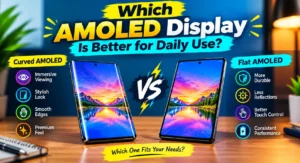
Final Buyer Verdict & Decision Matrix: Which One Should You Buy?
The decision between a Curved AMOLED display and a Flat AMOLED display hinges on individual user preferences, handling habits, and future considerations:
You Should Buy a Curved AMOLED Display If:
- Design and Style are Priority: You want your phone to look high-tech, chic and expensive when you show it off to other people.
- You Are a Heavy Media Consumer: You spend hours watching movies, TV shows and video reels, with an edge-to-edge wrap-around visual effect.
- You Handle Your Phone Carefully: You don’t drop phones often, use back covers regularly, and don’t care if you have to spend the extra money to get a good UV tempered glass or have it professionally installed.
You Should Buy a Flat AMOLED Display If:
- You Value Peace of Mind & Durability: You don’t want to pay ₹8,000+ to fix the screen if there is a chance of a drop or bump.
- You Are a Mobile Gamer: You require 100% accurate touch controls at any point on the screen without palm interference or control warping.
- You Prefer Low-Maintenance Protection: You want to purchase the cheapest ₹150 tempered glass online and install it in 2 minutes without messy liquid glue and easily mount any rugged armor case.
Conclusion: In the case of an average Indian consumer who uses the phone as a work tool on a daily basis, the Flat AMOLED display is the more sensible and more functional option. Even Samsung, a leader in the industry, has moved back towards flat screen designs for flagship devices such as the Samsung Galaxy S24 Ultra, demonstrating that these have proven to be more useful, durable, and accurate for long-term use than just some flashy display.
If it’s visual flair, bezel-less design, and ergonomic slimness that’s highest on your list however, a Curved AMOLED display model, such as the Realme 13 Pro+ and OnePlus 12 will still command attention if you care for it appropriately—making any prior smartphone side by side comparison india or flagship vs mid range camera comparison test evaluation a crucial step for your final choice.
🔗
📌”Samsung India — official Product Link”👈
