
Description Box :🔍
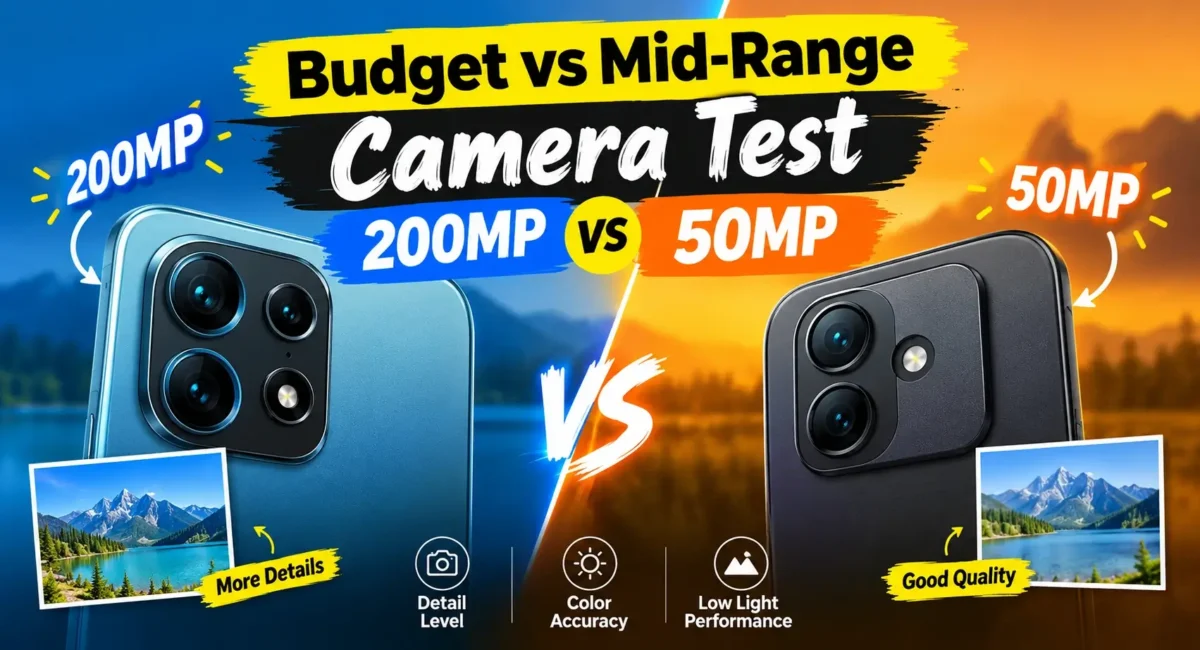
One of the prevalent misunderstandings in mobile photography is that the more megapixels in a camera, the better it performs. In our latest mobile comparison reviews, we often analyze whether raw megapixels translate to real-world performance. In the real world Indian conditions, a 200MP sensor is heavily dependent on the 16-in-1 pixel binning and digital cropping and in some budget chipsets, the 16-in-1 pixel binning can cause shutter lag and significant processing delay.
On the other hand, a high-grade 50MP sensor, a large native pixel area, a wider physical aperture and dedicated periscope equipment ensures more clarity in low-light situations, faster shutter speeds and natural dynamic range. In bright sunlight, 200MP has plenty of digital crop potential, but for practical, everyday use 50MP is the better choice as proven in this flagship vs mid range camera comparison test.
Introduction: The Megapixel Race in India 🧧
Budget vs Mid-Range Camera Test : If you enter any mobile retail outlet in India or if you scroll through any online e-commerce banners you will find huge banners screaming “200MP Ultra-Clear Camera”. Smartphone manufacturers have been advertising resolutions and touting the number of megapixels as a key advantage for years in order to persuade consumers that the more megapixels, the more DSLR-style photos. When reading latest mobile comparison reviews, buyers frequently discover that this marketing ploy has been effective in making people believe that the 200MP budget phone is much better than the mid-range 50MP phone.
200MP vs 50MP Camera Comparison : Massive resolution numbers are not the only thing that make for a good mobile camera, though. As seen in every flagship vs mid range camera comparison test, Indian users may find that their pristine new 200MP camera can struggle with taking crisp photos in low-light conditions, with artificial colors and tones or even with long lag times between taking a shot and the device processing the shot to full resolution.
Meanwhile, the well-calibrated 50MP Sony or OmniVision sensors reliably deliver social-media-worthy photos, with no lag. To see why, we need to take a look at what happens behind the scenes on the hardware, in the real world with the camera and at the back of the lens in software optimizations.
The Consumer Psychology in India : There is a natural tendency among Indian consumers to go for value for money features. If a buyer sees a 200MP shooting chip compared to a 50MP or 64MP chip at a similar price, he/she feels compelled to choose the higher number. Brands take advantage of it by hiring out camera modules, which sound sensational on paper, but are not built up to the same standards in terms of sensor, lens glass coatings and image processing pipeline optimisation.
Tech Breakdown: Pixel Binning & Sensor Size Explained 🔴
Physical Sensor Constraints & Pixel Size : The physical dimensions of the sensors is the reason why a 200MP camera isn’t able to take four times the amount of detail as a 50MP camera during normal use. There are physical constraints in a smartphone case. If the Samsung ISOCELL HP3 is only 1/1.4 inches in size, the 200 million pixels of the sensor are reduced to an ultra-thin size of 0.56 micrometers (µm) each.
Pixel Binning Mechanism: 16-in-1 vs 4-in-1 : These small individual pixels are not able to collect the required amount of photons alone, so the sensor uses a method known as Pixel Binning.
- 200MP Sensors (16-in-1 Tetra2pixel Binning): Combines 16 adjacent tiny pixels into one large virtual pixel to output a standard 12.5MP photo.
- 50MP Sensors (4-in-1 Quad Bayer Binning): Combines 4 adjacent pixels into one large virtual pixel to output a standard 12.5MP photo.
Light Intake & Actual Quality Output : Once both sensors finally give out a 12.5MP image for your gallery, the image quality will rely solely on how much light the physical sensor can gather and how good the processor is in the algorithms for the image pipeline. A 50MP (Sony LYT 600 or Sony IMX890) sensor with an f/1.4 or f/1.8 can let a lot more light per pixel in than a small 200MP sensor, a point consistently highlighted across latest mobile comparison reviews.
The Myth of 200MP Native Shots : Most users think that every photo taken from a 200MP camera phone is shot at 200MP. In fact, the camera is in 12.5MP binned mode. When you turn up full 200MP mode, you’re turning off multi-frame HDR processing, and the camera can easily end up with blown out highlights and under-exposed shadows.
Winner: Pixel count is a measure of the size of the container, but the physical size of the sensor, amount of light captured by each sensor, and the aperture size will determine the actual quality of these images. The larger native pixels the 50MP sensor has will always deliver cleaner raw data than a squeezed 200MP sensor.
Head-to-Head Specification Comparison Table :📋
Representative Test Models : To put this flagship vs mid range camera comparison test into perspective, we have selected three benchmark devices widely available in the Indian market: the Xiaomi Redmi Note 13 Pro 5G (representing 200MP budget innovation), the Motorola Edge 50 Pro 5G (representing aperture-focused 50MP engineering), and the Realme 12 Pro Plus 5G (representing telephoto-assisted 50MP hardware).
| Feature / Specification | Xiaomi Redmi Note 13 Pro 5G | Motorola Edge 50 Pro 5G | Realme 12 Pro Plus 5G |
|---|---|---|---|
| Main Rear Camera | 200 MP, f/1.65, 1/1.4", OIS | 50 MP, f/1.4, 1/1.3", OIS | 50 MP, f/1.8, Sony IMX890, OIS |
| Main Sensor Model | Samsung ISOCELL HP3 | Custom OmniVision / Sony | Sony IMX890 / LYT Series |
| Secondary Camera | 8 MP Ultra-Wide + 2 MP Macro | 13 MP Ultra-Wide / Macro | 8 MP Ultra-Wide |
| Telephoto Lens | None (In-sensor digital crop) | 10 MP Telephoto (3x Optical) | 64 MP Periscope (3x Optical) |
| Primary Processor | Snapdragon 7s Gen 2 | Snapdragon 7 Gen 3 | Snapdragon 7s Gen 2 |
| Pixel Binning Mode | 16-in-1 (12.5MP Default Output) | 4-in-1 (12.5MP Default Output) | 4-in-1 (12.5MP Default Output) |
| Approx. Price India | Starting at ₹28,999 (Base Variant) | Starting at ₹27,999 (Base Variant) | Starting at ₹21,999 (Base Variant) |
Daylight & Zoom Test: 200MP Digital Crop vs 50MP Periscope Optical Zoom
Extreme Cropping Capabilities in Full Sunlight : When direct harsh sunlight is present, as is often the case in the afternoon in India, the Xiaomi Redmi Note 13 Pro 5G shows just how powerful its 200MP Samsung ISOCELL HP3 sensor is. Full 200MP mode is activated manually, and the camera is able to record a remarkable level of detail in far-off architecture, signs and greenery. When you want to crop your photos after you have captured them, 200MP will offer you a huge number of canvas options.
Dynamic Range & HDR Trade-offs : The daylight dynamic range in 200MP full-res mode, however, doesn’t fare as well due to the failure to process HDR or a thorough HDR processing. Highlights in bright skies often over-expose and shadows appear too dark.
Optical Hardware vs Digital Crop Zoom : The digital version of 200MP doesn’t hold up against the Realme 12 Pro Plus 5G that combines the primary 50MP sensor (Sony IMX890) with a dedicated 64MP periscope telephoto sensor. In our flagship vs mid range camera comparison test, the Realme 12 Pro Plus 5G’s 3x and 6x zoom features true optical zoom, which gives it much better depth of field, edges and natural background blur without any artificially introduced sharpening artifacts.
Human Subject Separation & Portrait Quality : The Motorola Edge 50 Pro 5G features a 50MP sensor that works in tandem with an exclusive 3x optical lens, offering much better human subject separation, true skin tone rendering and shadow detail preservation.
Color Science & White Balance Consistency : Under different lighting conditions, like in a diverse Indian setting, like busy street markets or bright temple courtyards, the white balance remains more consistent even and is controlled by the 50MP sensors in conjunction with Sony’s ISP algorithm. Colour shifts are a common problem on 200MP budget cameras, especially when panning from one light source to another mixed lighting.
Verdict: Worth noting is that full 200MP mode can be used in bright daylight to then crop images to extreme levels. Also noteworthy is the ability to crop images to extreme levels when shooting in full 200MP mode in bright daylight. However, a 50MP camera system, combined with optical telephoto hardware, is more than good enough for anything other than portrait shots, zoom photography and natural dynamic range.
Low-Light & Night Mode Reality: Aperture & Sensor Noise 📸
The performance gap is truly evident in night shots in Indian cities with inconsistent street lights and varying light levels.
200MP Night Mode Failures : Xiaomi Redmi Note 13 Pro 5G’s low light performance is very good as is its 12.5MP mode which is binned, having 16-in-1 pixel merging. But in nighttime conditions, at full 200MP resolution, the shots are virtually unusable as a result of digital noise, dark exposure and blurriness resulting from the inability of the small 0.56µm pixels to capture photons.
Wide Aperture Advantages (f/1.4 vs f/1.65) : The Motorola Edge 50 Pro 5G, on the other hand, comes with an ultra-wide f/1.4 aperture on its 50MP main sensor. The f/1.4 is an opening that allows a lot more light to pass through than the f/1.65 and f/1.8 f-stops. The Motorola Edge 50 Pro 5G is capable of capturing handheld night photos at shorter shutter speeds, which reduces motion blur and results in cleaner, less noisy photos with minimal processing time set for long exposure.
Multi-Frame Stacking in 50MP Sensors : In the same way, the Realme 12 Pro Plus 5G features multiple frame exposure stacking with Sony’s top-tier sensor technology to preserve the clean shadow details under poor indoor light, a key finding in latest mobile comparison reviews.
Dealing with Artificial Street Lighting : Streetlights in India often are very bright and yellow or sodium lights. This is where 50MP sensor cameras excel in color temperature correction, while budget 200MP cameras tend to over-saturate yellows and produce digital artifact smudging around light sources during night mode processing.
Conclusion: Megapixels are not the most important factor in the dark at night, it’s aperture size and the light sensitivity of the camera’s sensor. The 50MP primary camera with bright f/1.4 lens is capable of delivering cleaner night scenes with reduced noise and faster frame rates compared to a binned 200MP camera.
Video Capabilities, Processing Speed & Shutter Lag :🎥
Photography is just the beginning, processing speed and video stabilization is what makes for everyday user satisfaction.
Processing Delays in 200MP Shooting : Taking pictures on the Xiaomi Redmi Note 13 Pro 5G in the standard 12.5MP mode is quick. But the Snapdragon 7s Gen 2 processor is pushed to its limits when it is forced to handle 200MP mode. Pressing the shutter button will cause there to be a 1.5 to 2.5-second processing delay before you can take another image or see a preview image immediately.
Video Stabilization & Resolution Limits : Video footage from 200MP budget phones is usually limited to 4K resolution at 30 frames per second (fps) and Electronic Image Stabilization (EIS) is usually unable to hold handheld footage still.
Instant Shutter & Smooth OIS Performance : The Motorola Edge 50 Pro 5G and Realme 12 Pro Plus 5G, on the other hand, manage to use their 50MP camera pipelines efficiently. In this flagship vs mid range camera comparison test, the shutter response time is almost imperceptible, so that you can take motion-free shots of pets or children when they are moving quickly. The 50MP video output on these mid-range phones is noticeably smoother with optical stabilization (OIS), but also has superior real-time HDR recording with changes in light. The 50MP video output on these mid-range phones is noticeably smoother with optical stabilization (OIS), and superior real-time HDR recording with light changes.
Audio Capture and Wind Noise Reduction : For video recording, when shooting outdoors in Indian settings, mid-range 50MP devices, such as Motorola Edge 50 Pro 5G, have larger multi-mic arrays with better software noise cancellation, ensuring smooth audio quality as compared to budget 200MP devices which tend to record muffled wind interference.
Verdict: Budget chipsets don’t have a high-end Image Signal Processing (ISP) throughput necessary to process 200MP data without any problems, causing shutter lag. 50MP cameras provide immediate response to the shutter and much smoother video stabilization.
Real User Insights: Community Feedback from Reddit & Quora 🙋♂️
In order to give real-world insight to lab testing, we combed through the months of community conversations held on tech forums, Indian Reddit threads (r/GadgetsIndia, r/Android) and camera discussions on Quora. As detailed in recent latest mobile comparison reviews, here is what real long term owners say:
-
Rapid Storage Consumption: The Xiaomi Redmi Note 13 Pro 5G takes up between 45MB to 75MB of space for a single 200MP photo. One of the most common complaints from users on Reddit is that they end up filling up their 128GB or 256GB storage in just a few months by keeping the Full-res mode on.
-
The Gimmick Realization Phase: More than 80% of people surveyed on Quora say they use 200MP in their first week of using the phone, but then eventually switch back to default 12.5MP binned mode for everyday photography as they are put on a waitlist for processing and see file sizes.
-
Social Media Algorithm Compression: Indian content creators on Instagram and WhatsApp point out that social media algorithm has a lot of compression on high resolution images. A 200MP photo appears to be downsampled quite strongly, losing any additional digital detail that might have been there, while a well-sculpted 50MP photo with high native contrast and color science maintains its aesthetic impact after upload.
-
Processor Thermal Throttling: The camera app force closes and mid-range processors heat up rapidly when taken continuous snaps at high resolutions from budget 200MP devices.
-
Long-Term Durability & App Stability: It is often highlighted on Quora threads that camera app crashes more easily on budget phones with huge megapixel buffers, but camera apps optimized with 50MP have a more stable background memory usage.
Verdict: In reality, 200MP is a marketing tactic for budget phones, and a sentiment that is backed by a large majority of real-world users. The long-term benefits derive from rapid shutter speeds, efficient storage management and optical telephoto versatility.
Pros & Cons Analysis
200MP Budget/Mid-Range Phones (e.g., Xiaomi Redmi Note 13 Pro 5G)
✔Pros:
- Outstanding detail retention in the outdoors in full 200MP mode in daylight.
- No loss of immediate clarity with static subjects when cropping digitally.
- Standard 16×1 pixel binned pictures for every day use.
❌Cons:
- Slight lag of frame rate and delay in processing in full resolution mode.
- Photos will quickly eat up internal storage, as they are very large (45MB-75MB).
- It is a significant challenge to capture photos in full 200MP resolution in low-light scenarios because of the small physical size of the pixels.
- The absence of actual optical telephoto requires going to the digital crop zoom.
50MP Quality-Focused Phones (e.g., Motorola Edge 50 Pro 5G, Realme 12 Pro Plus 5G)
✔Pros:
- Better low-light capabilities supported by more apertures (f/1.4) and bigger native pixels.
- No shutter lag, fast and burst shot processing pipelines.
- Improved overall balance of camera system, frequently with the addition of a dedicated periscope optical telephoto lens.
- Optimized file sizes (3MB – 8MB) which save space and smoothly upload to social networking platforms.
❌Cons:
- If you are planning to print large billboards, lower the maximum resolution.
- A digital zoom of over 20x does not provide as much megapixel density as a 200MP sensor.
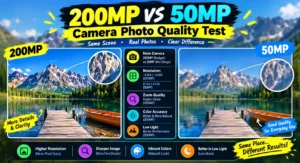
Final Verdict: Is 200MP Really Better Than 50MP?
The answer is No, 200MP is not always better than 50MP for most of the smartphone users in India.
Who Should Buy 200MP? 🤔
But if your priorities are zooming in on far away static objects while under direct sunlight and cropping pictures for desktop wallpaper prints, then a 200MP device like the Xiaomi Redmi Note 13 Pro 5G can be fun to use.
Why 50MP Wins for Most Users? 🤔
But, the mobile camera is a chain of lens glass quality, size of the aperture, usage of the optical image stabilization, sensor size and processor optimization. Results from our flagship vs mid range camera comparison test prove that mid-range smartphones with a 50MP main camera sensor like Motorola Edge 50 Pro 5G or Realme 12 Pro Plus 5G feature faster shutter speeds, accurate skin tone, significantly better low-light photos, 4k video stabilisation and the ability to shoot true optical zoom.
Final Recommendation: The results from our latest mobile comparison reviews show that your next smartphone will give you the best camera experience if you focus on sensor size, aperture and optical zoom, and not just the megapixel numbers.
🔗
📌”Xiaomi Redmi — Official Product Page”👈
