Description Box :🔍
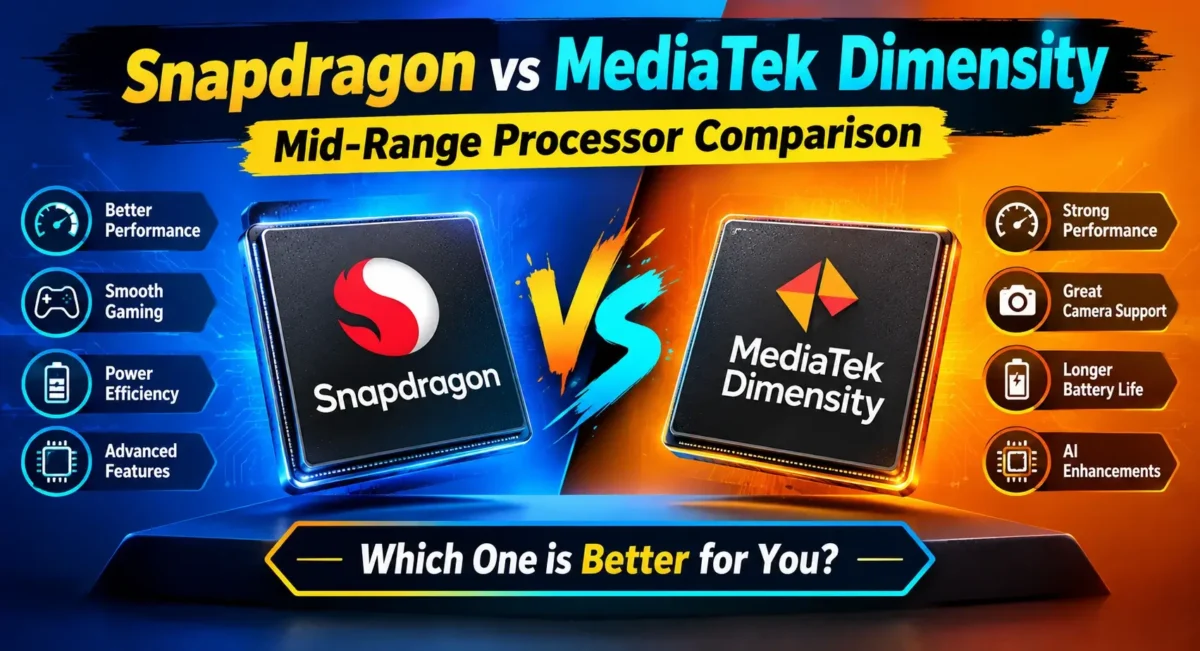
The Snapdragon vs MediaTek Dimensity: Mid-Range Processor Showdown clearly shows just how competitive the smartphone segment in India is in the price band of ₹15,000 to ₹30,000. When evaluating a real world mobile performance comparison, Qualcomm is the only provider that’s got the stability, support and ISP image processing of the GPU, while MediaTek Dimensity excels at raw CPU scores, power-saving and the price-to-performance ratio. The decision between them is one of balancing software stability for the long run versus performance per rupee.
1. Overview: The Mid-Range Chipset Battleground in India 🧧
Snapdragon vs MediaTek Which is Better : The price segment ranging from ₹15k to ₹30k in the Indian smartphone industry is the most competitive segment in the mobile technology market. Slow performance, battery problems, and shoddy camera performance are no longer acceptable to consumers. The battle of mid-range smartphones is being fought in the heart of every smartphone, namely the System-on-Chip (SoC) where Qualcomm Snapdragon 7 Series (Snapdragon 7 Gen 3, 7s Gen 2, 7s Gen 3) is on one side and MediaTek Dimensity series (Dimensity 7200, Dimensity 7300, Dimensity 8300 Ultra) are on the other side.
In the past, Qualcomm had a near-monopoly on high end silicon. MediaTek chips were once considered as low-end devices with the risk of battery consumption and thermal throttling. But the processor landscape has now been changed due to MediaTek’s move away from the aged 16nm manufacturing nodes to the new 4nm ones of TSMC, and ARM’s new core architectures.
Snapdragon vs MediaTek Dimensity : Mid-Range Processor Showdown will look at the actual technical details and user feedback from Indian tech forums and provide a detailed analysis of various aspects including performance, thermals, gaming stability, ISP performance, 5G support, and device health over time.
Verdict: Overall, the raw compute power and efficiency of MediaTek are more appealing at lower device pricing points, while Qualcomm’s ability to develop more effective camera processing algorithms and software support is a clear advantage in every flagship vs mid range camera comparison test.
2. Core Architecture & Manufacturing Process (4nm Efficiency) :🔴
The efficiency and the maximum sustained performance of a processor is largely dependent on its fabrication process node and CPU cluster design. Both Qualcomm and MediaTek use TSMC (Taiwan Semiconductor Manufacturing Company) and Samsung Foundry for manufacturing their chips, but they have different core layout approach.
Fabrication Process & Node Efficiency : The new mid-range chipsets have now moved to 4nm process. Both the Snapdragon 7 Gen 3 and the Dimensity 8300 Ultra make use of the 4nm node from TSMC, which guarantees minimal current leakage and low power consumption in light-use scenarios such as browsing the web, scrolling through social media and viewing videos. On the other hand, if you are looking for a mid-range device, you can get a Snapdragon 7s Gen 2, which is built using the 4nm process — and that is a process that is slightly hotter to run than chips made by TSMC.
CPU Cluster Design :Qualcomm has adopted a new CPU configuration of 1+3+4 in its high-end middle-of-the-range devices (such as the Snapdragon 7 Gen 3):
- 1x Prime Core: ARM Cortex-A715 clocked at ~2.63 GHz for quick app launching and single-threaded tasks.
- 3x Performance Cores: ARM Cortex-A715 clocked at ~2.4 GHz for multitasking and gaming.
- 4x Efficiency Cores: ARM Cortex-A510 clocked at ~1.8 GHz for background tasks.
MediaTek takes a more aggressive approach with processors like the Dimensity 8300 Ultra:
- 4x Performance Cores: ARM Cortex-A715 clocked up to 3.35 GHz.
- 4x Efficiency Cores: ARM Cortex-A510 clocked at 2.2 GHz.
Dimensity chips are able to pump out greater multi-core scores on Geekbench 6 with higher clock speeds on each of the four performance cores versus a similarly priced Snapdragon chipset.
Verdict: Overall, in a real world mobile performance comparison, the Dimensity processor made by TSMC is able to beat Snapdragon 7s-series chips with regard to raw CPU multitasking and thermal efficiency per watt, while high-end Snapdragon 7-series processors maintain strong single-core CPU performance and thermal efficiency.
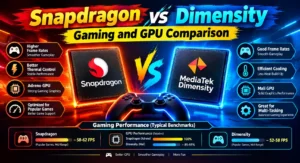
3. Gaming & GPU Performance: Adreno vs. Mali / Immortalis 🕹
Popular multiplayer games like BGMI (Battlegrounds Mobile India), Call of Duty: Mobile, Free Fire Max, and the offline games, which are difficult like Genshin Impact, play a significant role in gaming performance in India. The GPU is a crucial aspect that decides the frame rate’s stability in this Snapdragon vs MediaTek Dimensity: Mid-Range Processor Showdown.
Qualcomm Adreno GPU Performance : Qualcomm has built-in its own Adreno GPUs, such as Adreno 720 for Snapdragon 7 Gen 3. Adreno GPUs are well-known for their game optimization. Often game developers test their code first on Snapdragon-based systems. Key highlights include:
- Frame Rate Stability: Higher sustained frame rates over 45–60 minute gaming sessions with flat frame curves.
- Thermal Throttling Control: Adreno GPUs reduce clock speeds gradually when ambient temperatures rise, preventing sudden frame drops or micro-stutters during intense team fights in BGMI.
- Vulkan API Optimization: Efficient handling of graphics pipelines in modern game engines.
MediaTek Mali / Immortalis GPU Performance : MediaTek is using ARM Mali GPUs, such as Mali-G615 MC6 on Dimensity 8300 Ultra and Mali-G610 MC6 on Dimensity 7200/7300.
- Peak Graphical Power: MediaTek Mali GPUs deliver better peak frame rates in short bursts (for example, 90 FPS mode in supported games without any hassles).
- Thermal Behavior: Without physical cooling measures, MediaTek devices can have more severe temperature throttle curves, resulting in a 15-25% drop in performance to keep the device cool under prolonged loads.
Verdict: Overall, MediaTek Dimensity offers competitive graphics performance for raw first frame per second (FPS) and shorter gaming sessions. Any accurate real world mobile performance comparison reveals that Qualcomm Adreno GPUs allow for longer gaming sessions with no drops in frames or jitter though however.
4. Camera, ISP & Image Signal Processing (Spectra vs. Imagiq) :📸
The Image Signal Processor (ISP) of a chipset dictates photo processing speed, dynamic range, skin tone accuracy, noise reduction and video stabilization.
Qualcomm Spectra ISP : Qualcomm’s Snapdragon 7-series gets 12-bit or 14-bit triple ISPs (such as Qualcomm’s Spectra ISP). Key advantages include:
- Natural Color Science: Snapdragon ISPs process skin tones more naturally in varied lighting conditions, which stands out in a flagship vs mid range camera comparison test.
- Zero Shutter Lag & Multi-Frame Noise Reduction (MFNR): Shutter speed remains fast, capturing sharp pictures of moving objects in low light.
- 4K HDR Video Capture: Smooth electronic image stabilization (EIS) combined with real-time HDR tone mapping.
- GCam (Google Camera) Compatibility: Snapdragon hardware natively supports third-party GCam ports, allowing users to extract pixel-level camera quality through custom software configs.
MediaTek Imagiq ISP : MediaTek has its Imagiq ISP suite (e.g., Imagiq 760 / 920). Key advantages include:
- High Megapixel Support: Fast hardware demosaicing for 200MP camera sensors.
- AI Noise Reduction (AI-NR): Dedicated APUs (AI Processing Units) to reduce grain during night time shots.
- Video Processing: Smooth 4K @ 30fps recording with some aggressive software sharpening sometimes showing up on secondary ultra-wide cameras during a flagship vs mid range camera comparison test.
Verdict: MediaTek has managed to bring the photo quality catch-up to a significant extent, but in any comprehensive flagship vs mid range camera comparison test, Snapdragon chipsets are still the better choice for video stabilization, low light image quality, and third party GCam installation.
5. 5G Network, Connectivity & Indian Band Support :⚡
A seamless 5G connectivity, band support and power efficiency during network switch is important for Indian smartphone users who are on Reliance Jio and Bharti Airtel networks.
Qualcomm Snapdragon Modems : Qualcomm integrated modems (such as 5G Modem-RF Systems Snapdragon X63 / X65) have a good telecommunication integration:
- 5G Standalone (SA) and Non-Standalone (NSA): Full support for key Indian 5G bands, including n1, n3, n5, n8, n28, n40, n41, n77, and n78.
- 3-Carrier Aggregation (3x CA): Combines multiple 5G frequency bands simultaneously to deliver high download speeds and stable indoor reception.
- Smart Transmit Technology: Dynamically adjusts RF transmission to conserve battery power when signals are weak.
MediaTek 5G UltraSave Technology : MediaTek’s 5G UltraSave technology is integrated into MediaTek’s 5G modems:
- Band Coverage: Works on all Indian 5G bands below 6GHz with fast 4G to 5G switching times.
- Battery Drain Efficiency: UltraSave 3.0+ automatically optimizes the power consumption based on network conditions to ensure the battery is not consumed as much as possible during non-essential background 5G data.
Verdict: Both processor family support full Indian 5G band coverage and carrier aggregation too. When conducting a real world mobile performance comparison, Qualcomm has a small advantage in low signal strength when inside, but MediaTek does the best job at saving network power on the go.
6. Comprehensive Specification Comparison :📋
The following table provides a direct technical breakdown of top mid-range chipsets powering smartphones in India between ₹15,000 and ₹30,000.
| Specification / Feature | Qualcomm Snapdragon 7s Gen 2 | Qualcomm Snapdragon 7 Gen 3 | MediaTek Dimensity 7200 / 7300 | MediaTek Dimensity 8300 Ultra |
|---|---|---|---|---|
| Fabrication Node | 4nm (Samsung) | 4nm (TSMC) | 4nm (TSMC) | 4nm (TSMC) |
| CPU Architecture | 4x Cortex-A78 (2.4 GHz) / 4x Cortex-A55 (1.95 GHz) | 1x Cortex-A715 (2.63 GHz) / 3x Cortex-A715 (2.4 GHz) / 4x Cortex-A510 (1.8 GHz) | 2x Cortex-A715 (2.8 GHz) / 6x Cortex-A510 (2.0 GHz) | 4x Cortex-A715 (3.35 GHz) / 4x Cortex-A510 (2.2 GHz) |
| GPU Model | Adreno 710 | Adreno 720 | ARM Mali-G610 MC4 / Mali-G615 | ARM Mali-G615 MC6 |
| RAM Support | LPDDR4X / LPDDR5 | LPDDR5 | LPDDR4X / LPDDR5 | LPDDR5X |
| Storage Support | UFS 2.2 / UFS 3.1 | UFS 3.1 | UFS 2.2 / UFS 3.1 | UFS 4.0 |
| AnTuTu v10 Score (Avg.) | ~580,000 – 620,000 | ~820,000 – 860,000 | ~680,000 – 730,000 | ~1,350,000 – 1,420,000 |
| Geekbench 6 (Single/Multi) | ~940 / 2,800 | ~1,150 / 3,350 | ~1,040 / 2,950 | ~1,520 / 4,850 |
| Max Display Refresh Rate | Full HD+ @ 144Hz | Full HD+ @ 148Hz / WQHD+ @ 120Hz | Full HD+ @ 144Hz | Full HD+ @ 180Hz / WQHD+ @ 120Hz |
| 5G Network Support | Sub-6GHz (SA/NSA) | Sub-6GHz (SA/NSA) | Sub-6GHz (SA/NSA) | Sub-6GHz (SA/NSA) |
| Wi-Fi / Bluetooth | Wi-Fi 6, Bluetooth 5.2 | Wi-Fi 6E, Bluetooth 5.3 | Wi-Fi 6E, Bluetooth 5.3 | Wi-Fi 6E, Bluetooth 5.4 |
| Popular Indian Devices | Realme 12 Pro 5G / Poco X6 5G | Honor 200 5G / Motorola Edge 50 Pro | Nothing Phone (2a) / Vivo T3 5G / iQOO Z9 | Poco X6 Pro 5G |
| Approx. Device Price Range | ₹15,999 – ₹21,999 | ₹24,999 – ₹29,999 | ₹17,999 – ₹21,999 | ₹23,999 – ₹27,999 |
7. Pros & Cons Breakdown
Qualcomm Snapdragon Mid-Range Series
✔Pros:
- Game Optimization: Improve frame rendering and maintain stable FPS in BGMI and CoD Mobile with more developer assistance.
- Camera Processing: Spectra ISP offers uniform color calibration, faster shutter speeds, and top-notch video capture, performing remarkably well in a flagship vs mid range camera comparison test.
- GCam Porting: Full support for the Camera2 API allows custom Google Camera apps to be installed.
- Thermal Consistency: The balanced power curves reduce hunky-dunky CPU throttling.
❌Cons:
- Pricing: MediaTek based devices cost less than those powered by Snapdragon.
- Synthetic Benchmark Scores: Slightly lower multi-core Geekbench and AnTuTu scores than comparably priced Dimensity models.
MediaTek Dimensity Mid-Range Series
✔Pros:
- Benchmark Leader: Sub-₹25,000 devices with flagship compute capabilities.
- Energy Efficiency: The battery life is solid, thanks to Energy Efficiency, which is achieved by the TSMC 4nm architecture and 5G UltraSave.
- Fast Storage Compatibility: UFS 3.1 and UFS 4.0 storage interfaces gaining wide-ranging acceptance in low-cost phones.
- Value for Money: Low silicon cost means brands can incorporate superior displays, faster charging speeds and more value in the price.
❌Cons:
- Developer & Custom ROM Support: A proprietary source code restricts developer and long-term community custom ROM development.
- Thermal Throttling: During heavy, extended gaming sessions it’s possible for the device to heat up quite rapidly if it’s not properly cooled by liquid.
8. Custom ROMs, Developer Support & Software Updates :🕵️♂️
Developer community support is crucial for users who intend to use their smartphones for 3-4 years.
Snapdragon’s Custom Kernel Advantage :
Shortly after Qualcomm releases new silicon, it releases the kernel source codes to the open-source community. As Qualcomm launches new silicon, it releases kernel source codes to the open-source community. As a result:
- The developers behind custom ROMs (LineageOS, Pixel Experience, Evolution X) create stable custom operating systems for older Snapdragon devices.
- Owners of smartphones will be able to upgrade their phones’ Android software long after the manufacturer’s support period has ended.
- There is a ton of driver updates and/or custom GPU tuning modules available on developer forums such as XDA-Developers and Reddit.
MediaTek’s Closed Ecosystem :
MediaTek has enhanced its code sharing policies, although the release of source code is still not sufficient and fast enough:
- MediaTek phones are not as easy to get custom ROMs for as other phones.
- In most cases, installing custom kernels and/or camera ports (GCam) is not stable, because there are missing library files.
Verdict: If you are looking for long-term custom software support, device modding and long term OS longevity, Qualcomm Snapdragon is the better platform to use.
9. Real-World User Scenarios: Which Processor Should You Choose?
The best option is yours to decide between Snapdragon and MediaTek Dimensity in this Mid-Range Processor Showdown as it comes down to your use case and budget.
Scenario A: The Hardcore Mobile Gamer :🚀
- Primary Need: highest frame rates, quick load times and low thermal throttling.
- Top Pick: MediaTek Dimensity 8300 Ultra (e.g., Poco X6 Pro 5G, ~₹23,999).
- Why: Provides more than 1.3 million AnTuTu points, supports UFS 4.0 storage for quick game loading and maintains 60–90 FPS without any drop in popular modern games based on a real world mobile performance comparison.
Scenario B: The Daily User & Photography Enthusiast :📸
- Primary Need: Natural photos, stable performance in video recording, clean software, and long battery life.
- Top Pick: Qualcomm Snapdragon 7 Gen 3 (e.g., Motorola Edge 50 Pro / Honor 200 5G, ~₹24,999 – ₹29,999).
- Why: Excellent ISP color management, reliable point and shoot camera reliability proved in every flagship vs mid range camera comparison test, and stable TSMC 4nm battery usage.
Scenario C: The Budget-Conscious All-Rounder :😎
- Primary Need: Balanced Daily Tasks, Decent 5G Support, Good Display Refresh Rate and Low Price.
- Top Pick: MediaTek Dimensity 7200 / 7300 (e.g., Nothing Phone 2a ~₹20,999 / Vivo T3 5G ~₹17,999).
- Why: Better performance than older 6-series processors and basic 7-series processors, but keeps the price of the devices under ₹22,000 in India.
10. Final Verdict & Buying Recommendation for Indian Users :🙌
MediaTek’s edge over Qualcomm is significant less in the mid-range category. MediaTek is not just a budget option anymore, but it also brings in the performance, power saving and hardware value to the sub-₹25,000 category.
-
MediaTek Dimensity: If you are looking for maximum raw processing power, high benchmark scores, smooth multitasking and maximum performance for each rupee under ₹25,000, as shown in any real world mobile performance comparison, then MediaTek Dimensity is the option for you.
-
Select Qualcomm Snapdragon for camera stability, prolonged gaming thermal performance, software modding capabilities, and system durability.
In conclusion, Indian customers in 2026 have excellent options as both chipsets deliver solid performance. The processor capabilities are just the beginning, specific phone features, like cooling system size, display quality, software skin optimization, and camera sensor hardware, will help you make the right selection.
🔗
📌”Honor India — Official Product Page”👈
